Openculture.com has posted a summary of films staring Richard Feynman. The documentaries include The Pleasure of Finding Things Out, The Last Journey of a Genius, and No Ordinary Genius which were made between 1981 and 1993. These documentaries or anything with Feynman is pure joy to watch.
Interest of the day
A blog about miscellaneous topics.
Openculture.com has lists of free ebooks, movies, audio books and courses for that new Kindle, tablet, and iPad.

Brady Haran at Sixty Symbols has posted an extend version of the Higgs Boson interviews. It a bit long but so very interesting.
US News and World Report magazine has posted their Best Colleges for 2012 report. You can search for colleges that offer online degrees now which is very handy. The report lists the best engineering colleges and provides info on colleges with engineering specialties. As you might have guessed, MIT, Stanford, and UC Berkeley are the top rated universities that offer Ph.D programs.
Professor Dennis Hong from Virgina Tech gives this interesting TEDx talk on My seven species of robot. His humanoid robots are a amazing and can play soccer. These robots known as DARwIn-OP (Dynamic Anthropomorphic Robot with Intelligence - Open Platform) won the 2011 RoboCup which was a international challenge with 24 teams competing.
Update: You can find more information about DarwIn-OP from Robotis and it sells for $12,000 (I think).

Update: You can find more information about DarwIn-OP from Robotis and it sells for $12,000 (I think).
Brian Cox describes why an atom is mostly space in the humorous video. Simmon Pegg helps out with the discussion.
Okay, it's time to get your notebook out and pop some popcorn. The online Colleges website has posted 100 Amazing Videos for Teaching and Studying Physics. There looks to be a lot of good lectures here. I very much enjoyed Brian Greene's Fabric of the Cosmos that aired recently on PBS. I see that Lisa Randall has a lecture on the list and will likely be at the top of my watch list.

Don Lincoln from Fermilab describes how scientist search for the Higgs Boson in this short YouTube video. The video describes the possible particles the Higgs Boson might decay into and how the probability changes with the mass of the Higgs Boson. The energy levels that have not been excluded ranges from 115 GeV to 145 GeV at the time the video was made (an electron has a mass of 0.511 GeV for reference). CERN will be hold a press conference tomorrow to discuss the latest results. Looking forward to hearing some new results. Will the Standard Model still be standing? Perhaps, the documentary about the fate of the Standard Model could be call: Last particle standing.
Cambridge University has posted Issac Newton's notebooks online in high-resolution. The notebooks include:
There are links to videos on his works as well. Nicely done and thank you Cambridge.
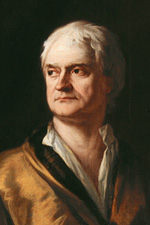
- Trinity College Notebook (MS Add. 3996) This is a notebook Newton acquired while he was an undergraduate at Trinity College and used from about 1661 to 1665...
- College Notebook (MS Add. 4000) This small notebook was probably used by Newton from about 1664 to 1665. It contains notes from his reading on mathematics and geometry...
- Waste Book (MS Add. 4004) Much of Newton's important work on calculus is developed in this large notebook, which he began using in 1664 when he was away from Cambridge due to the plague...
- Early Papers (MS Add. 3958) This set of papers documents some of Newton's early mathematical thinking, work that would develop into his theories of calculus...
- Hydrostatics, Optics, Sound and Heat (MS Add. 3970) This large accumulation of papers dates from about 1672-1706. It includes drafts of his book on Opticks and other miscellaneous writings.
- Philosophiæ Naturalis Principia Mathematica (Adv.b.39.1) Newton's monumental Principia was published in July 1687 and brought him international fame...
There are links to videos on his works as well. Nicely done and thank you Cambridge.